ARCHIVE
TRACES OF FORM· SELECTED RECORDS FROM THE HOUSE ARCHIVE
The Archive records the making of In Regione Caecorum: unfinished pieces, engraved surfaces, stone arrangements, workshop fragments and objects in development.
It follows material as it becomes form - through construction, setting, engraving and final surface. Images remain minimally explained, allowing attention to rest on proportion, texture and detail.
IRC · XVII · 2026 · PROTOTYPE / GEOMETRY DEVELOPMENT RECORD
ORDA · RING
ORDA began as a sketch and was first developed through a bronze ring blank to test the initial geometry. The form was then refined in 3D CAD before moving into a silver prototype, used to resolve the engraving, setting architecture and final surface treatment prior to the 18K gold commission.

IRC · XV · 2025 · CAD / CONSTRUCTION DEVELOPMENT RECORD
MĀMŌNĀ · EARRINGS
MĀMŌNĀ was developed in 3D CAD to create a setting specifically for this commission rather than relying on a standard basket construction. The four-prong architecture was designed around restraint, open sides and a clear profile, allowing the two 1.80 ct natural diamonds to remain visually dominant while giving the earrings their own distinct structure.
The approved design moved through CNC wax milling and casting into 18K white gold, followed by successive stages of refinement, polishing and stone setting. Particular attention was given to the interior surfaces of the baskets, which were brought to a mirror finish so that the hidden construction received the same level of finish as the visible exterior.
The archive records the progression from digital design to finished object: 3D CAD, CNC wax milling, casting, surface refinement, mirror polishing and setting.

IRC · XIII · 2025 · FORM / ENGRAVING DEVELOPMENT RECORD
MANIFESTO · TAROT DICE
MANIFESTO began as an attempt to give physical form to a system already deeply familiar to its intended owner — the Major Arcana of Tarot, approached not as imagery alone, but as a structure for reflection, divination and transcendence.
The object was developed as a way of concentrating that system into a single tactile form: twenty-two Arcana, together with YES and NO, distributed across twenty-four faces.
The archive records the progression from this initial idea into geometry, gold, hand engraving and stone placement. Each face was developed as an individual field within a larger whole, allowing the finished object to function simultaneously as a divination instrument, a sculptural form and a personal object of contemplation.

IRC · XI · 2025 · CAD / SETTING DEVELOPMENT RECORD
ANDRAS · RING
ANDRAS was developed in 3D CAD around an unusual setting in which the centre trillion-cut diamond is supported by the three outer stones. The construction required closely matched stone dimensions and precise control of angles, spacing and contact points before the piece moved into gold.

IRC · IX · 2025 · DEVELOPMENT RECORD
CLASSICAL ENGAGEMENT · SET
Crafted in 18K yellow gold, XIV brings together an engagement ring and a pair of convertible earrings, centred around three natural diamonds of one carat each. The classical halo design is carried throughout the set, with differences in scale and construction giving each piece its own character.
The ring features a one-carat diamond surrounded by two concentric halos of smaller diamonds, the finest measuring 1.2 mm. Along the shank, diamonds gradually decrease in size from 2.1 mm to 1.5 mm, extending the brilliance of the central setting around the band.
The earrings offer two ways of wearing the same diamonds. Each one-carat stud can be worn independently, revealing the simplicity of the central stone, or combined with a detachable diamond-set halo jacket for a fuller, more elaborate silhouette. The removable construction allows the earrings to change character without changing their central setting.
The entire set was developed in 3D CAD and produced through CNC wax milling, including the individual stud settings and their matching halo jackets. Traditional in appearance, the work combines carefully graduated stone arrangements with the versatility of a convertible design.

IRC · IX · 2025 · CAD DEVELOPMENT RECORD
SEA YOU · RING
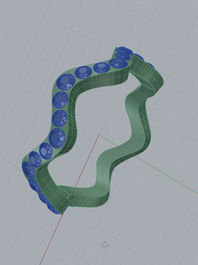
SEA YOU was developed as a paired ring composition around a shared wave geometry. The form was resolved in 3D CAD and tested through a physical model before moving into metal. Natural sapphires and diamonds, graduated from 1.5 to 2 mm, were micro-set across the two bands.
IRC · VI · 2025 · DEVELOPMENT RECORD
OPUS IV · RINGS
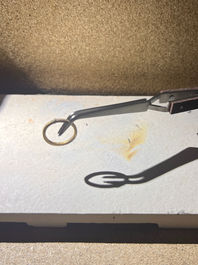
OPUS IV was developed from the outset as a four-ring cycle for a single wearer. The rings were completed and delivered at approximately three-month intervals, following the sequence of Nigredo, Albedo, Citrinitas and Rubedo.
Each stage retains the traditional eternity-ring form while introducing different gemstones and setting techniques. NIGREDO was executed with natural black diamonds in enhanced castle setting. ALBEDO and CITRINITAS feature natural white and yellow diamonds in variations of the traditional fishtail setting. RUBEDO, set with rubies, was completed using enhanced fishtail engraving, with more elaborate hand-cut detailing in the gold.
IRC · V · 2024 · SETTING / HANDWORK DEVELOPMENT RECORD
PHENEX · RING
The setting of PHENEX was developed directly on a narrow gold ring blank rather than pre-formed into the design. Each diamond position was marked individually, then drilled, cut, engraved and set by hand. The process allowed the fishtail-derived pattern to evolve directly in the metal while maintaining the delicate scale of the finished ring.

IRC · IV · 2024 · HANDWORK / STONE LAYOUT DEVELOPMENT RECORD
ALTIORA · RING
ALTIORA began from a plain gold ring blank. The sapphire layout was developed around natural variations in colour, with black and white diamonds used to interrupt the rhythm. The entire setting was then drilled, cut, engraved and completed by hand.

IRC · III · 2024 · HANDWORK / STONE LAYOUT DEVELOPMENT RECORD
TRANSCENDUM · RING
The design of TRANSCENDUM originates with Gerardi Setting School in Rome. Realised by In Regione Caecorum in gold and diamonds, the ring begins from an unadorned gold blank — a simple, uninterrupted form from which its entire surface architecture is developed by hand.
Every stone position is established individually. The gold is drilled, cut and engraved by hand, gradually transforming the plain surface into a disciplined structure of diamonds, edges and bright-cut detail. The setting is not applied to a pre-formed decorative pattern; it emerges through successive intervention into the metal itself. The handwork remains fully visible in the finished surface: each cut, edge and setting forms part of the final architecture.
Within In Regione Caecorum, this execution is titled TRANSCENDUM. The name refers to passage from one state into another. Here, that idea is held quite literally in the making of the ring: a restrained gold form is progressively altered through cutting, engraving and setting until its original surface has become something entirely different.
Light completes this transformation. It moves between diamond and engraved gold, revealing the depth and rhythm created by the hand-cut structure. TRANSCENDUM is therefore concerned not only with the finished form, but with the act of becoming — material carried from one state into the next through precision, repetition and work.


STATUS
THE ARCHIVE CONTINUES...
New records enter as objects take final form.